Flower of Life
The Pattern of Interlocking Circles
Meaning
What is the
Flower of Life?
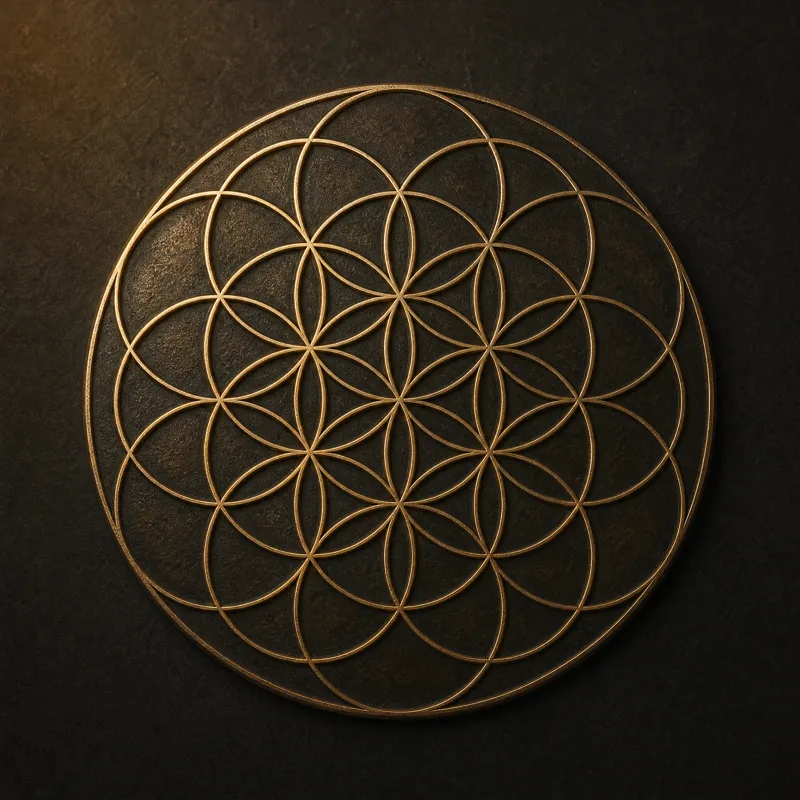
The Flower of Life is a pattern of 19 circles of equal radius, each centred on the outline of its neighbours. This simple compass construction produces a highly regular figure made of petals and hexagons. It has become one of the best-known emblems of sacred geometry.
Symbolic frequency
528 Hz
Element
Water · Cosmos
Themes
Creation · Universal Love · Interconnection
History & Origin
Where does this symbol come from?
Flowers of Life are drawn on a pillar of the Temple of Osiris at Abydos, Egypt; their dating is debated, and they are probably much more recent than the temple. Interlocking circles also adorn Roman mosaics, and Leonardo da Vinci studied their construction in his notebooks. The name "Flower of Life" itself spread in the late 20th century.
The construction
Step by step, with a compass
All it takes is a compass, a single opening and one simple rule: each new circle is centred on a crossing of the previous ones.
01
One circle
The starting point. Its radius is used for every other circle.
02
The vesica piscis
A second circle centred on the outline of the first. Their overlap forms an almond shape.
03
The Seed of Life
Seven circles: one in the centre and six around it, each centred on the outline of the central one.
04
The Flower of Life
Carrying on from the new crossings gives nineteen circles.
05
Fruit of Life and Metatron’s Cube
Thirteen circles that touch without overlapping. Joining their centres two by two gives Metatron’s Cube.
In numbers
circles of equal radius in the Flower of Life
circles around each centre, on a hexagonal grid
the ratio of the height to the width of the vesica piscis
segments join the 13 centres of the Fruit of Life in Metatron’s Cube
Through the centuries
Where it is found
7th century BCE
Khorsabad, Assyria
A grid of interlocking circles decorates an alabaster door sill from an Assyrian palace at Dur-Sharrukin (now Khorsabad, Iraq). It is the oldest known example.
Source: Louvre Museum, inv. AO 19915; Wikipedia, “Overlapping circles grid”
1st century BCE
Herodium, Judea
The floor of a bathhouse in Herod’s palace carries a mosaic of seven interlocking circles: the Seed of Life.
Source: Wikipedia, “Overlapping circles grid”
Disputed dating
Temple of Osiris, Abydos (Egypt)
Nineteen-circle figures are drawn in red ochre on granite columns. They are graffiti, much later than the temple: they are usually dated to the first centuries CE, though a more recent origin cannot be ruled out.
Source: M. A. Murray, The Osireion at Abydos (1904); Wikipedia
13th century
Westminster Abbey, London
The Cosmati pavements, in marble and coloured stone, use interlocking circle patterns.
Source: Wikipedia, “Overlapping circles grid”
1478-1519
Leonardo da Vinci, Codex Atlanticus
Among his many geometry studies, Leonardo draws interlocking circle figures and studies their proportions.
Source: Codex Atlanticus, fol. 307v and 309v (Biblioteca Ambrosiana, Milan)
The name “Flower of Life” is modern: it spread through New Age publications, in particular Drunvalo Melchizedek’s book The Ancient Secret of the Flower of Life (1999).
Practice
Contemplating the symbol
Settle somewhere quiet, with the symbol in front of you.
Follow one circle with your eyes, then the next, from the centre outward.
Spot the petals and hexagons that appear where the circles cross.
Draw the figure with a compass: seven circles are enough to start.
Collection
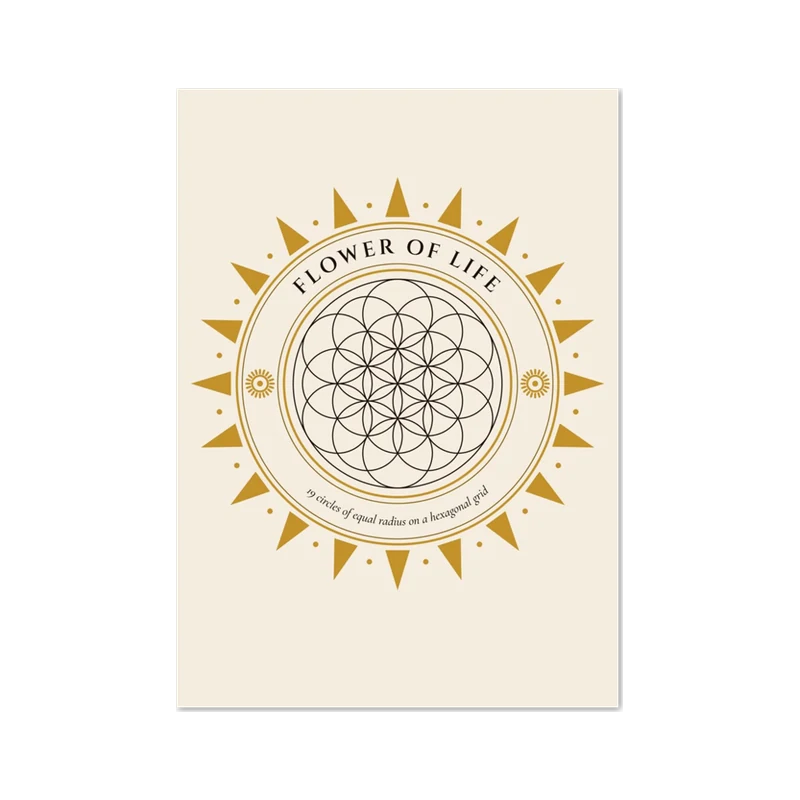
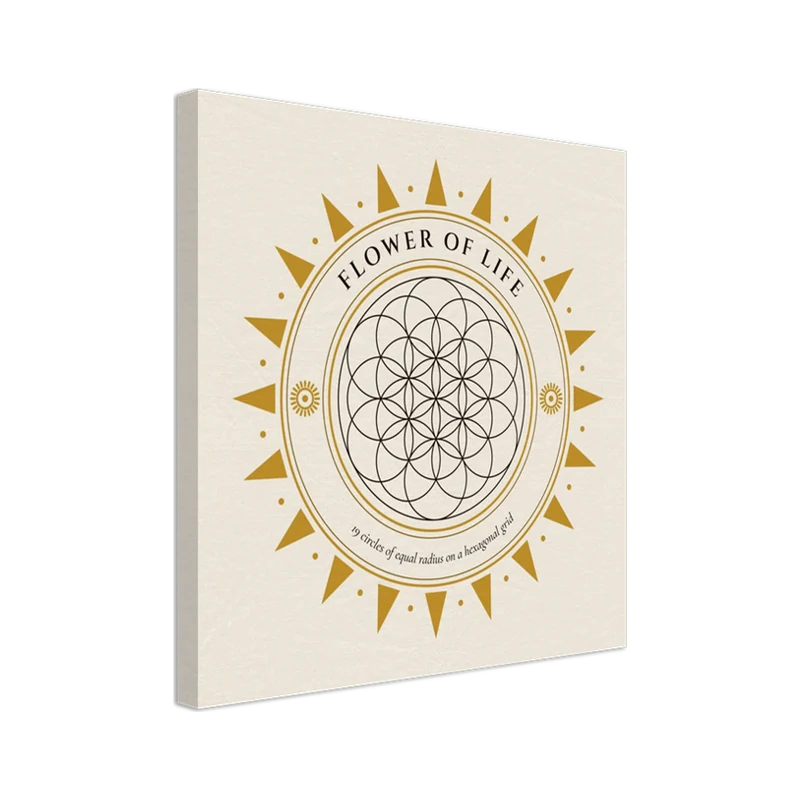
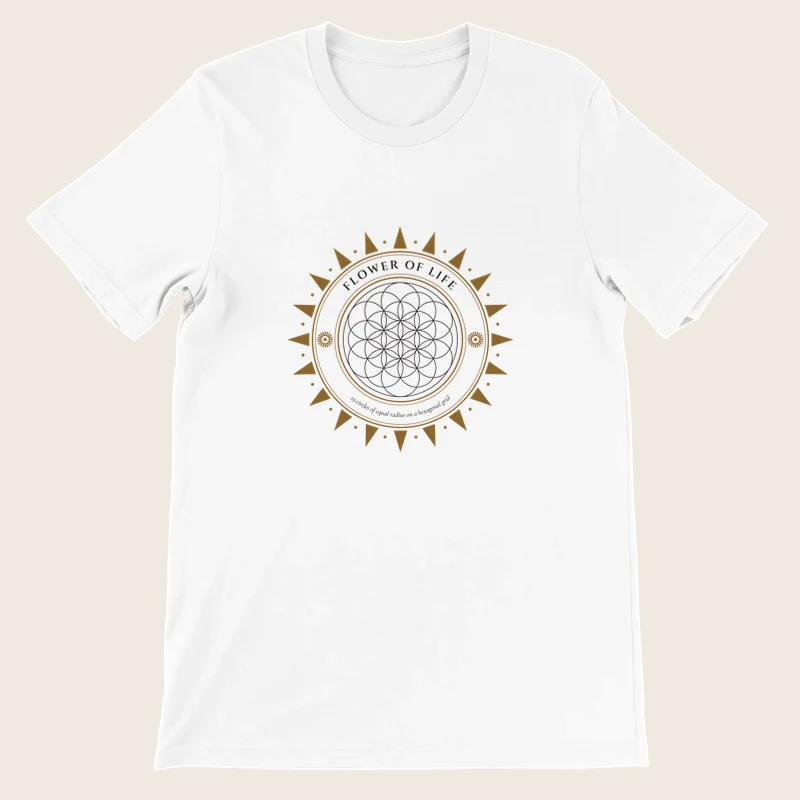
Wear the Flower of Life
Is the Flower of Life really your symbol?
Five questions to find the symbol that suits you.
Take the quizExplore other symbols